

According to the law on financial undertakings, Arctica Finance is obligated to abide by recognized guidelines for corporate governance.
Arctica Finance's board of directors abides by the corporate governance guidelines issued by the Iceland Chamber of Commerce, Nasdaq Iceland and SA Confederation of Icelandic Enterprise. Good governance promotes improved work practices and communication which increases trust between shareholders, the board, management, employees and other stakeholders.
María Rúnarsdóttir, Chairman of the Board, is an independent investor. Prior María was CFO of SMI ehf. and Korputorg ehf., a consultant at KPMG and CFO of SVAR technologies ehf., as well as being one of the founders of MINT Solutions ehf. María is currently on the Boards of several companies. María has an MBA degree from MIT (Massachusetts Institution of Technology) in Boston, US and a B.Sc. degree in business administration from the University of Reykjavik.
Erlendur Svavarsson, Board Member, has worked in the airline industry since 1992, when he began his career at Air Atlanta and later MD airlines. In 2003 Erlendur joined Loftleiðir Icelandic ehf. In 2008 Erlendur became Senior Vice President for Business Development at Icelandair Group. From 2010 until 2023 Erlendur waw a Senior Vice President at Loftleiðir Icelandic. Erlendur has been the CEO of AJW Capital, which is an international investment company in the aviation related industry, from 2024. Erlendur has served on the board of many of Icelandair Group‘s subsidiaries. Erlendur has a B.A. in Russian and Economics from the University of Iceland, an MBA from Reykjavik University and AMP from Harvard Business School.
Þórir Kjartansson is the CEO of Icelandic Investments ehf. Þórir is a civil engineer from the University of Iceland and has an MBA from IESE in Barcelona. Þórir has been an independent investor since 2000 through Íslensk fjárfesting ehf., which he owns and operates in cooperation with another man. Þórir has held various positions , such as being on the board of the National University Hospital of Iceland for a few years. Þórir is on the board of various companies, including Íslensk fjárfesting ehf. and several of its subsidiaries.
Gísli Þór Arnarson, alternate Board Member, has a C.S degree in Construction Engineering from the University of Iceland and an MBA degree from the University of Louisville in the USA. Gísli is the managing director of the sales and services department of Terra umhverfisþjónusta hf. From 2006 - 2025, Gísli Þór worked for Samskip hf. group, first as director of Samskip‘s import department and then as a member of the management board of Samskip hf. and the chief executive officer of Samskip innanlands ehf. Previously Gísli worked for three years in the import division of Eimskip and another three years before that as an engineer and business consultant at The Corradino Group.
Þórhalla Sólveig Jónsdóttir, alternate Board Member, has a B.Sc. degree in Business from the University of Iceland, with empasis on marketing and management, and an MCF degree in corporate finance from Reykjavik University, as well as having a degree in securities brokerage in Iceland. Þórhalla Sólveig was director of Middle Office at Icebank 2007 - 2009 and director of the claims process at LBI's liquidation board 2009 - 2018. Þórhalla Sólveig also sits on the board of Málefli, an interest organization for the benefit of children and adolescents with speech and language disorders, and was appointed to a steering group organized by the Ministry of Health regarding work on the integration of services for children who need speech pathology services.
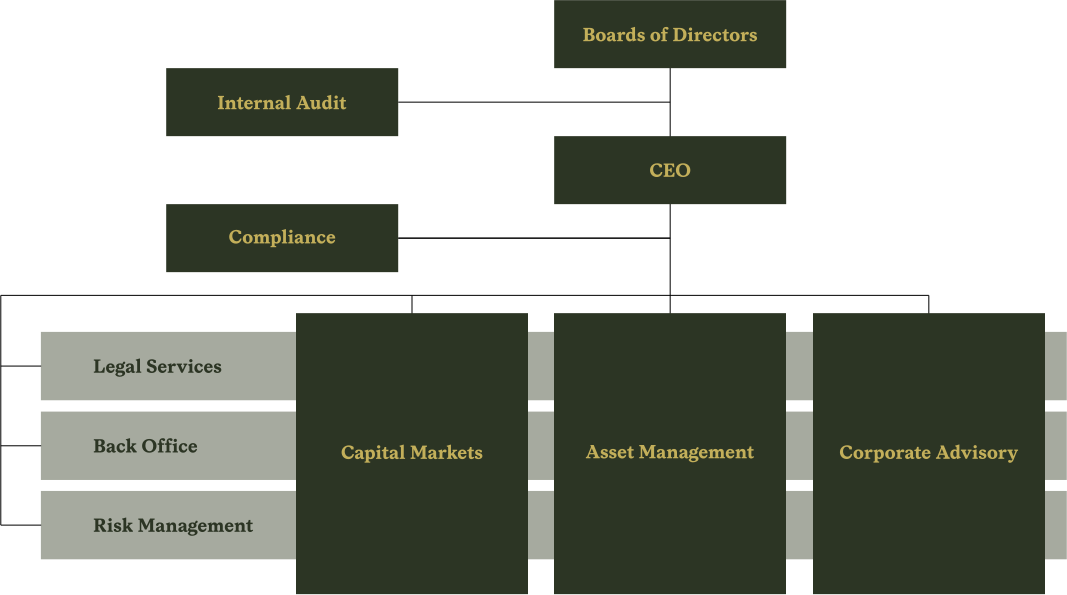
The management and control of Arctica Finance is divided between the shareholders, the board and the chief executive officer in accordance with the company's articles of association, the rules of the board and other recommendations of the board. The management and control of the company is also subject to various laws and regulations, including the law on limited liability companies, the law on financial undertakings, the law on measures against money laundering and terrorist financing, the regulation on prudential requirements for the activities of financial undertakings and the rules of the Stock Exchange, as well as various guiding recommendations of the Financial Supervisory Authority. A more detailed description of the laws, rules, regulations and guidelines can be found on the Financial Supervisory Authority's website.
Corporate Governance Statements
Annually, Arctica Finance assesses whether the company's governance is in accordance with recognized guidelines for corporate governance.Subsequently, a statement on Arctica Finance's governance is published in a separate section of the annual accounts, which can be found below. Arctica Finance's governance is also discussed in the company's annual report.
The Board‘s Rules of Procedure
The rules of procedure of the Arctica Finance board of directors are established on the basis of art. 70 in act no. 2/1995, on limited liability companies, art. 54 in act no. 161/2002, on financial undertakings, and art. 18 of the company's articles of association, taking into account the guidelines of the European Banking Authority (EBA). The rules of procedure also take into account the aforementioned guidelines on corporate governance.
The Board‘s Rules of Procedure can be found in Icelandic (Icel. starfsreglur stjórnar) here.
Articles of Asssociation
Arctica Finance's articles of association can be found in Icelandic (Icel. samþykktir) here.
Articles of Asssociation for Arctica Finance in Icelandic
Remuneration Policy
The board of Arctica Finance is obligated to approve a remuneration policy and it is submitted annually to the company's general meeting, and it can be found in Icelandic (Icel. starfskjarastefna) here.
Remuneration Policy in Icelandic
Annual accounts
The annual accounts of Arctica Finance are prepared in accordance with the law on annual accounts and rules on the financial statements of securities companies and securities brokers, and it can be found in Icelandic (Icel. ársreikningar) here
Sustainability
In September 2020, Arctica Finance signed a joint declaration of intent between the Icelandic government and parties representing nearly 80% of assets in the Icelandic financial market, on investments in the interest of sustainable development. In doing so, Arctica Finance committed to taking into account “Iceland’s international obligations and the benchmarks set by the Icelandic government.” These include the goal of a carbon-neutral Iceland by 2040, the Paris Agreement’s goal of limiting greenhouse gas emissions to 1.5 degrees Celsius, and the United Nations’ Sustainable Development Goals for 2030.
Where appropriate, ESG/UFS, the United Nations Principles for Responsible Banking (UN PRB), the United Nations Principles for Responsible Investment (UN PRI), the UN Global Compact, etc. are also taken into account. Arctica Finance has been a member of IcelandSif since January 2019, which is an educational platform for responsible investments that contributes to enhancing investors’ knowledge of sustainable and responsible investment methodologies. Annually, Arctica Finance compiles a report on non-financial information that addresses UFS aspects and it is published in a special section in Arctica Finance’s annual accounts, which can be found below.
Disclosure of Sustainability Related Risksi
Transparency in sustainability risk policy (Article 3 of the SFDR)
Based on Icelandic Act No. 25/2023, on sustainability disclosures in financial services sector and a taxonomy for sustainable investments, regulation (EU) 2019/2088, on sustainability related disclosures in financial services (SFDR) has been implemented.
According to Article 3 of the SFDR, financial market participants must publish on their website information about their policies on the integration of sustainability risks in their investment decision-making process. Financial advisers must also publish on their website information about their policies on the integration of sustainability risks in their investment advice. Arctica Finance does not currently provide asset management services, but does provide investment advice and is therefore considered a financial adviser with reference to the above, but is not considered a financial market participant.
Sustainability related risk is “an environmental, social or governance event or condition that, if it occurs, could cause an actual or a potential material negative impact on the value of the investment” according to Article 2, point 22 of the SFDR.
Arctica Finance has a policy on responsible investments, which states, among other things that responsible investments are investment methods that take into account ESG factors in investment decisions with the aim of reducing risk and delivering sustainable returns in the long term.
A formal, harmonised assessment of ESG factors when assessing investment options has not been fully implemented, but on the other hand, the information on sustainability factors that is available is taken into account in the general assessment of investment options.
Arctica Finance has and will continue to work on implementing SFDR in the company's operations.
Transparency in relation to adverse impacts on sustainability at the unit level (e. Principal Adverse Impact on sustainability factors, PAI) (Article 4 SFDR)
Sustainability factors are “environmental, social and employee matters, respect for human rights, anti-corruption and anti-bribery matters” according to Article 2, point 24 of the SFDR. Principal adverse impacts generally refer to the negative impacts that an investment decision may have on the above mentioned factors.
Investments in the financial market are generally in financial instruments issued by companies, public entities and other issuers. The activities of these issuers inevitably have an impact on sustainability related to financial, environmental and social aspects (ESG). The impact can be negative and/or positive.
According to Article 4 in SFDR financial advisers shall publish and maintain on their website information on whether, taking into account their size, the nature and scale of their activities and the types of financial products they make available, they consider principal adverse impacts of investment decisions on sustainability factors, a statement on due diligence policies with respect to those impacts. If they do not consider adverse impacts of investment decisions on sustainability factors, clear reasons for why they do not do so, including, where relevant, information as to whether and when they intend to consider such adverse impacts, shall be disclosed.
Arctica Finance does not currently take into account the negative impact of investment decisions and investment advice on sustainability. The examination of the negative impact of investment decisions and investment advice on sustainability requires the renewal of existing internal processes, increased data collection and measurement, as well as non-financial information from companies and issuers.
These processes have not yet been developed and Arctica Finance believes that it is unable to carry out a proper assessment of the negative impact of investments on sustainability while non-financial information is still scarce and its quality is often inadequate. Work is underway to assess how data collection and monitoring should be carried out to assess the negative impact of investments on sustainability by size and type of issuer and different financial instruments, financial products and investment strategies.
Ongoing developments in the regulatory framework related to sustainability will be monitored. In parallel, Arctica Finance will seek to develop processes over time that will enable the company to collect and measure the main negative impacts of sustainability factors as data availability increases and disclosure improves.
Transparency of remuneration policies in relation to the integration of sustainability risks are incorporated (Article 5 of the SFDR). According to Article 5 of the SFDR, financial market participants and financial advisers must include in their remuneration policies information on how those policies are consistent with the integration of sustainability risks, and shall publish that information on their websites.
Arctica Finance's remuneration policy states that it aims to ensure that Arctica Finance is a competitive and desirable option for qualified and outstanding employees, thereby ensuring the company's competitiveness, development and acceptable profitability. The remuneration policy is intended to promote healthy operations in the long term and not encourage abnormal risk taking. Emphasis is placed on remuneration being competitive but not leading, and that when deciding on remuneration, responsibility and work experience shall be taken into account. The remuneration policy also includes the objectives of ensuring trust in the management and operations of Arctica Finance, that the company adheres to good governance and demonstrates social responsibility. The objective is also to consider the reputation and credibility of Arctica Finance, and that it operates in accordance with the standards, values and business ethics that are normal for investment firms in Iceland.
The current remuneration policy refers to how the policy addresses sustainability related risks and states that remuneration should “not encourage excessive risk taking with respect to sustainability related risks”. Arctica Finance believes that the above provisions and other provisions of the policy support moderate risk taking and a culture of considering sustainability risks in Arctica Finance's operations.
Arctica Finance's current remuneration policy is available above.
| Shareholders | Beneficial Owners | Shares* | % |
| Viti fjárfestingafélag ehf. | Bjarni Þórður Bjarnason and Stefán Þór Bjarnason | 87.611.506 | 50,00% |
| Ascraeus ehf. | Jón Þór Sigurvinsson | 15.461.034 | 8,82% |
| Jón Ingi Árnason | 15.416.666 | 8,80% | |
| Rúnar Steinn Benediktsson | 12.295.000 | 7,02% | |
| Börsen ehf. | Gunnar Jóhannesson | 7.786.741 | 4,44% |
| R38 ehf. | Grétar Brynjólfsson | 5.455.753 | 3,11% |
| K2 Invest AF ehf. | Þórbergur Guðjónsson | 5.455.753 | 3,11% |
| Sverrir Bergsteinsson | 4.540.000 | 2,59% | |
| Sveinn Þórarinsson | 4.540.000 | 2,59% | |
| Mánatindur ehf. | Andri Ingason | 3.302.500 | 1,88% |
| Valbeinn ehf. | Rut Kristjánsdóttir | 3.302.500 | 1,88% |
| Arctica Finance hf. | 10.055.558 | 5,74% | |
| In totalSamtals | 175.223.012 | 100,00% |
